

Career Limiting Injuries

First published: May 2008
Amongst the celebrations for Nick Stevens in the week of his 200th game of AFL football, we should be mindful of the severe neck injury he incurred over 2006 / 2007 and the chance that he may have never made it back to represent the Blues. Whilst Stevens has thankfully returned, the risk of “Career Limiting Injuries” remains in football - many Blues in our history have suffered from devastating injuries, with careers ended or curtailed in a single fleeting moment whilst out there in the sporting arena. The Blueseum would like to recognize and acknowledge such Blues, for those fleeting moments undoubtedly limited the careers and our adulation for the Carlton players listed below.
1. Noel O'Brien sustained an ankle injury - 31 games / 118 goals in 1954 / 1955
Noel O'Brien was a Full Forward who looked set for an outstanding career for Carlton – and in an era where Carlton was starved of success he ‘could have been anything’ for the Blues.
Carlton had recruited O’Brien from Echuca, and after a relatively quiet 1954 O’Brien boomed into a gun forward with 73 goals for the year. O’Brien’s 73 goals had him the second highest for the year and a comfortable winner of Carlton’s goal-kicking for the second successive year.
From that high came an astounding low - O’Brien would never recover from an injury sustained in a pre-season practice match in 1956, ending his career. Such was his impact that Carlton’s top goalkicker for 1956, Kevan Hamilton, would only manage 22 goals – less than 1/3 of O’Brien’s tally for the previous year.
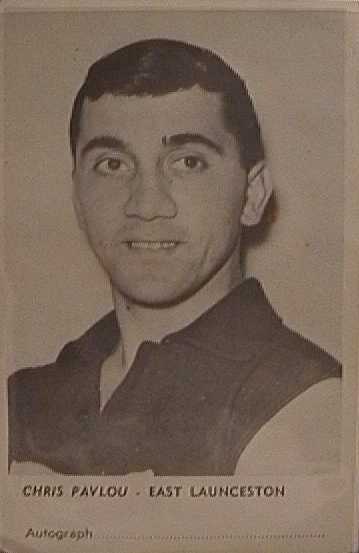
2. Chris Pavlou who suffered a career ending knee injury. 31 games; 9 goals; 1958 - 1961
A young Chris Pavlou may have had a relatively slow start to his career, but would be 2/3 of the way through a break-out season when his career would tragically end. Over 1961, Pavlou would come 4th in the Best & Fairest. “I kicked 3 against North Melbourne once as a rover, and one game on the wing against Melbourne I kicked 1 goal 4 against Brian Dixon. I was pretty happy with that but in the press Lou Richards remarked that I’d “Lost the game for Carlton” with those misses, but I had hit the post 3 times!”
Through the year, Pavlou would play 14 games off the wing and earn 8 Brownlow Votes – second only for Carlton behind Brownlow Medallist John James. “One day I played against Bob Skilton in 1961 – I got the Best on ground, 3 Votes for the Brownlow, and the day after I was asked to Channel 7 for an interview with Mike Williamson where I got a pair of shoes and a tin of paint as my prize.”
Later in the year, Pavlou’s promising career would come to its crushing end. “We were playing Footscray at the old Western Oval in Round 14, 1961. It was raining and windy. I just happened to go to the Half Forward Flank out on the wing, trying to keep the ball in. In my endeavour to keep the ball in, on the line, a Footscray player slipped and my leg locked underneath. I went back, but I had heard the snap…I couldn’t come off as we had both reserves on. With 10-15 minutes to go, the Coach put me in the forward pocket. I was in agony, but the ball approached, and I went to go in…but nothing happened. I collapsed and was taken off shortly after.” Pavlou had severely damaged his ACL and not only was his season over, but his playing career at this level too.
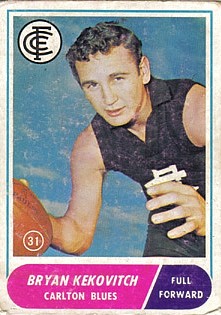
3. Brian Kekovich sustained a back injury – 34 games / 97 goals in 1967 / 1968
The older brother of North Melbourne champion Sam Kekovich, Brian was a star full-forward from Myrtleford who arrived at Princes Park in 1967 with huge expectations on his shoulders. In his 34 games for Carlton in two seasons, Kekovich showed the same mercurial ability as his brother later would, before his promising career was cruelly cut short by a chronic back injury in the midst of Premiership celebrations.
At 187 cm and 86 kg, with strong hands and a powerful left foot kick, Kekovich settled into a Carlton team on the rise and booted 36 goals in his first season to be our leading goal-kicker. A year later, Carlton would march into the 1968 Grand Final with a 36 point upset win over the Bombers in the second semi-final. In mid-season of that year, Brian had hurt his back when he was crunched in a marking duel, but ignored the pain and played on. He had made a big impression in only his second year of VFL football, booting 59 goals by the time the Blues met Essendon yet again on Grand Final day.
A strong, swirling cross-field wind turned the '68 Grand Final into a close, mistake-ridden encounter. The match was highlighted by Kekovich's four goals in Carlton's winning tally of seven; and wingman Garry Crane's superb game on the wing to be voted Best on Ground. Carlton won by 3 points to claim our first flag since 1947. Only a short while after the Grand Final - when Kekovich sought treatment for his back - the diagnosis came as a total shock. He was advised to retire from football immediately - or risk spending the rest of his life in a wheelchair. Unfortunately for him and for Carlton, Brian's short but successful career in the number 16 Navy Blue guernsey was over.
4. Adrian Whitehead sustained a foot injury – 63 games / 22 goals in 1994 – 1999
Adrian Whitehead was the youngest member of Carlton’s all-conquering 1995 Premiership team. He was an exciting and talented player before his career was cut short by a serious foot injury only two years later.
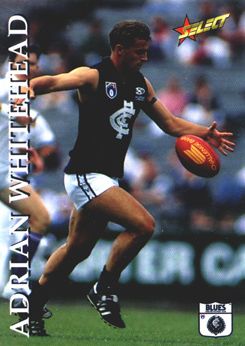
In that year, history tells us that Carlton lost only two games early before commencing a fabulous 16-match winning streak highlighted by our crushing 10-goal Grand Final victory over Geelong. Whitehead was one of nine Blues who didn’t miss a match all year. With his confidence growing, he had evolved into a hard-running, creative defender who regularly backed his judgement to launch attacks from deep in defence. He was outstanding in Carlton’s victory over the Adelaide Crows in round 15, earning an AFL Rising Star nomination.
By 1997, the potholes in Carlton’s team were beginning to show, and Blues’ supporters were looking for some positive news in the wake of the retirement of champions Stephen Kernahan, Diesel Williams and Justin Madden – all of whom proved irreplaceable. Carlton struggled throughout the year and were on the way to another heavy defeat against Geelong in round 20 when Whitehead hobbled off the ground injured. After treatment he returned to the field, but a subsequent examination revealed serious damage to the nerves and tendons in his troublesome foot.
He was unable to play at all in 1998 as he underwent a series of delicate operations. Late in the year he was back on his feet, but another season had begun by the time the club welcomed him back into training. Eventually, he was named on the bench for the round 13 game of 1999, against the North Melbourne Kangaroos at the MCG. Sadly, Carlton were beaten decisively, and Adrian realised that it was futile to continue, and retired immediately.
As a contact sport, we could indeed continue to tell the stories of careers ended or curtailed, such as Greg Kennedy, Tom Simmons and Matthew Allan. Beyond those that we know of, there would surely also be those injuries hidden or managed as careers advanced. We all know that injuries are common in our great game, yet perhaps amongst all of the stories of woe we do not celebrate the returns from devastating injury as best we could.
----
Part 2
Article first published: July 2009
They say injuries are a part of football. They say you should never blame injuries for losses, and that you have to take it on the chin. A certain level of injuries are often said to be 'acceptable' and within the realms of what each Club has to endure as it stakes it's claim for the Premiership Flag each year. But all of this ignores the human side of the coin; the side that might see a career end - or be severely debilitated - from a single split second event. Here at the Blueseum we're mindful of recognising not only the Stars that constantly receive our acclaim, but also those that succumbed to injury well before their time.
1. Tom Simmons who never made it back to football after a knee injury. 27 Games; 23 goals; 1948-1949.
A superbly built 6 footer, Tom Simmons was a star junior all round athlete winning the 100 and 200 yard championships of Melbourne Technical School’s as well as the high and long jump titles. He also won the 220 yards dash at the Inter-Technical schools championship at Olympic Park. Later, the warm days of summer were filled by playing seconds for the Carlton Cricket Club.
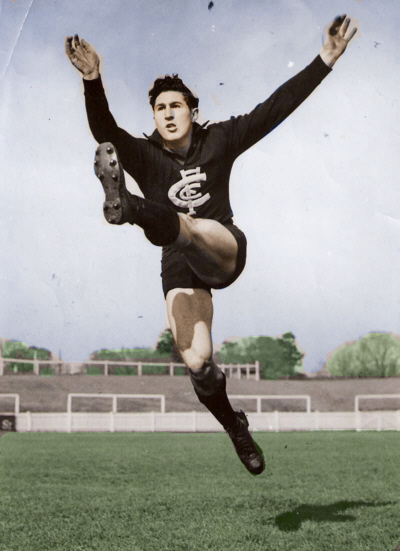
But he was also an up-and-coming footballer of note. Tom amassed an impressive 27 games in just two years playing mainly on either half back flank or half forward flank for the Blues all before the age of twenty one. During this time Tom’s display of impressive pace, long kicking, high marking and a determined appetite for the ball made him a difficult opponent for opposition teams. Laurie Kerr opined, ""He looked and performed like Mighty Mouse on the field."" Umpire Harry Beitzel referred to young Simmons on the field as ‘Champion’. He was Carlton's Best First Year Player in 1948, and the future looked bright.
Then in a pre-season game before the 1950 season a knee injury tragically struck down the young athlete. After two knee operations full fitness eventually returned to the point where in the professional running season over the summer of 1950-51 Tom won the Terang, Ararat and Maryborough Gifts within a few short weeks. Then a decision had to be made, continue on the lucrative professional running albeit on shorter marks for events such as the Bendigo 1000 and Stawell Gift or attempt to resurrect a fledgling footy career. Tom chose to return to his beloved Blues aiming to fill the hole left by the retirement of Carlton full forward Ken Baxter.
Regular track watchers had observed the young Simmons at training taking spectacular marks over seasoned veterans such as Bert Deacon and the towering Jack Howell. With pace to burn and a strong pair of hands the position of full forward seemed a natural progression. It is not clear what happened next; perhaps the demands of the lateral movement of football rather than the straight running of sprinting that pressured an already weak knee or perhaps it was the sudden rise of freakish goalkicker Keith Warburton but sadly Tom never got to play another senior game for the Blues.
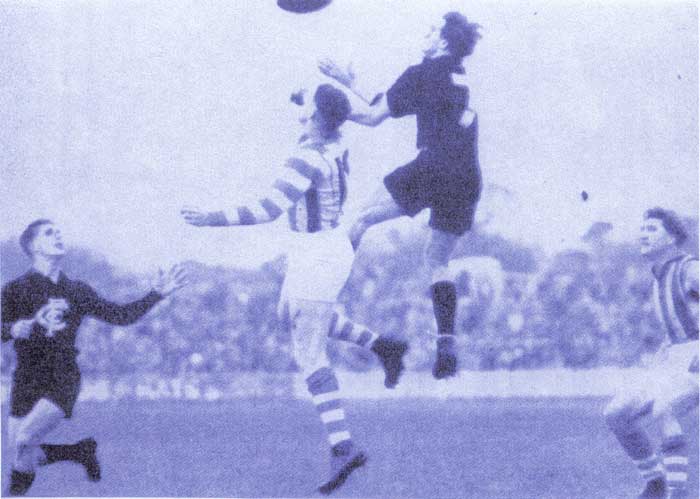
2. Keith Warburton who was forced to retire given damaged kidneys. 74 games; 91 goals; 1951-1955
The excitement around Warburton may indeed have damaged Simmons' career prospects, but Warburton's career itself was shortened dramatically from successive abdominal injuries.
Keith Warburton was an outstanding Full Forward with the then VFA Club Brighton when he was recruited by Carlton in 1951. He was not a big man; standing just 178cm and weighing 79kg; but he was lightning quick and became famous from his first game (when he kicked 7 goals) for his incredible ability to take freakishly high marks in an acrobatic manner.
At a dance during the '52 Final Series; he collapsed as a result of a body blow during that day's game; and was rushed to hospital where he hovered near death for a worrying period; but eventually recovered after blood was donated from the public following an urgent appeal. He returned in '53; but in '54 got another knock to the kidney (which was later removed) and he reluctantly retired at age 26. Overall, Keith played 74 games in Navy Blue between 1951 and 1955, kicking a total of 91 goals.
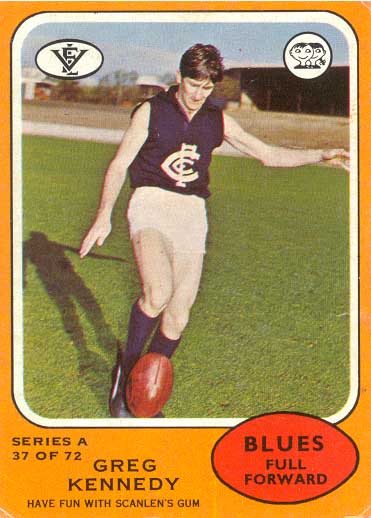
3. Greg Kennedy who struggled to come back from a back injury; 1972 - 1975
Greg Kennedy was a rangy, high-leaping full-forward from Eaglehawk, whose brilliant debut season showed why he was courted by Carlton for five years before he arrived. Eventually, they got their man when Kennedy was added to a strong Carlton squad in 1972. Enjoying silver service ball delivery from the likes of Trevor Keogh, Barry Armstrong and Syd Jackson, he had a stellar year.
Blues supporters were licking their lips after Round 21, when Kennedy played a blinder against Hawthorn. Marking everything that came his way, he dominated the game to kick 12.3 in Carlton’s 68 point demolition of the Hawks. Only the great Horrie Clover has ever done better for Carlton, with 13 goals in a game. Kennedy’s season tally of 79 goals won him the club goal-kicking award, and Carlton were minor premiers by two points over Richmond. But he would struggle in 1973, succumbing to injury and perhaps poor form:
""Unfortunately I injured my back the following season (1973) and it forced me to miss all of 1974. Against advice, I came back in 1975, but in the end I retired with 143 goals in 48 matches. That's an average of three goals a game, so I am pretty pleased with that. And I noticed that my name is still in the Football Record for 12 goals for the Blues - only Harry Clover with 13 has kicked more in a game. I was a carpet layer all my life, even during my footy days. I spent 32 years on my knees. So it was hardly surprising that I needed new hips. When I couldn't go back to carpet laying, I became a courier.""
Article by Rod Nicholson for the Sunday Herald Sun Sports' section March 29, 2009 page 32
4.Andrew Phillips sustained a back injury – 42 games / 26 goals in 1989 – 1991
Andrew Phillips was a rover in the true Carlton mould of the 1980s mosquito fleet. Quick, dangerous and with an eye for goal, Phillips was able to rotate between a forward pocket, half forward and the midfield with ease, exploding onto the scene as a 19 year old in 1989. A clever snap against Collingwood in the last quarter of round 15 sealed a 6 point win for Carlton and signalled his arrival as a senior player.
However, the back troubles which were to ruin his career emerged at the beginning of the 1990 season. The injuries restricted him to just 10 senior appearances for the year. He did manage another dozen games for the reserves that year and he was awarded the reserves best and fairest honour.
He battled through 1991 and was rewarded with state selection for Victoria. Playing at the Gabba, he kicked the goal of the match early in the game and showed he was not out of place at the highest level. Yet by the end of the year, his Carlton career was over. His degenerative back condition could not stand the rigours of AFL senior football and the number 19 rover was destined to fall short of the 50 game mark, yet Phillips still came 3rd in Carlton's Best and Fairest count of that year.
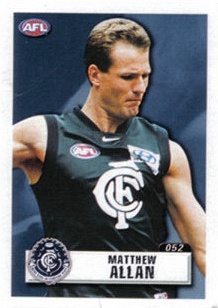
5. Matthew Allan who suffered a series of foot injuries. 140 games; 1994-2003
Recruited from North Ringwood where he only started playing as a 14 year old, Matthew Allan was drafted as a zone selection and spent a number of years on the list as the understudy to Justin Madden before finally given his go. When finally given the responsibility of being number 1 ruckmen in 1996 - 7 as Madden began to decline, Allan delivered on his promise.
Allan had a massive season in 1999 when he was All Australian, won the club Best and Fairest and played in the Grand Final. He would manage 19 goals, as a ruckman, and break his own impressive average disposals output with 15.6 per game. The left footed Allan was famous for taking the ruck but - as distinct from the traditional kick behind play - would move forward to steal a goal or two, sometimes 3. In some games, Allan despite his size appeared to be all over the field. He became a key player over 1998 - 2000. It would seem the man's endurance was supreme, especially for one of his height. But was it his undoing?
Allan suffered a series of serious foot injuries over 2001 to 2003 reduced Allan from league leading ruckman to a guy who struggled to train. He managed just 8 games in 2001, 4 in 2002 and 6 in 2003. It was a sad sight to see one of our young players struck down - we effectively lost him at just 26 years of age (2001).
As acceptable as injuries have sadly become, they remain an inevitable outcome from our great sport. But be sure to remember that many past players have suffered seriously as part of the game they love, and that may have diminished their ability to compete at the top level.
Last updated by Club Archive ·